Stop Taking Orders Through Instagram DMs: When to Build a Real Ordering System
Missed Instagram DMs and after-hours orders can cost an EU small business €45,000+ a year. Warning signs, the cost math, GDPR risks, and the practical fix.
The universal pain: another order, or another question?
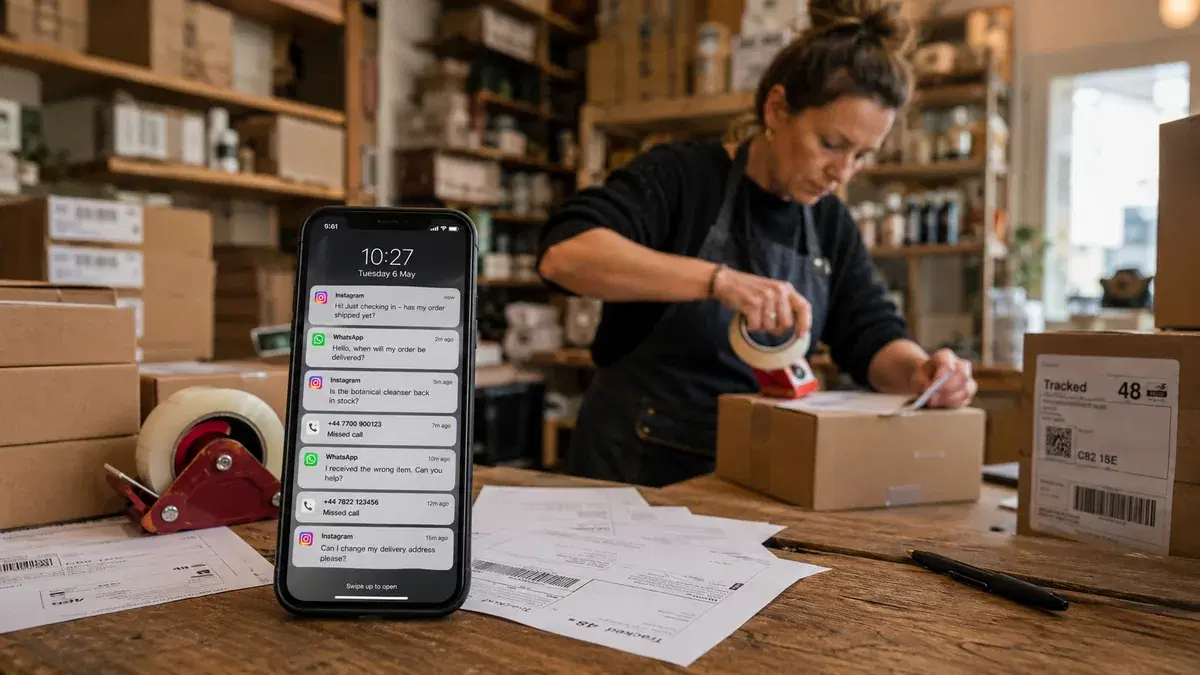
Every owner who sells through Instagram, WhatsApp, Facebook Messenger or phone calls knows the feeling. The phone buzzes mid-service.
Is it a new order? A question about opening hours? A supplier?
You cannot tell without stopping what you are doing. And whatever you are doing — plating food, cutting hair, wrapping a bouquet, ringing up a customer — is the thing the person physically in front of you is paying for.
This is not a discipline problem. It is not a "reply faster" problem. It is structural. Your busiest selling hours are exactly when you have the fewest free hands to answer messages.
And in 2026, customer patience for slow replies has collapsed to minutes — not hours.
Waiting just five minutes to respond to a customer enquiry increases your risk of losing them by 10×. At ten minutes, the risk increases by 100×. Source: Drift lead-response research.
Meanwhile, restaurants miss an average of 34% of calls during peak hours. Only about one in three callers ever tries again. They simply order from someone who picked up.
Beauty, retail and service businesses face the same dynamic in their DM inboxes every single day.
The 7 warning signs you've outgrown DM ordering
If you recognise three or more, the math has already turned against you.
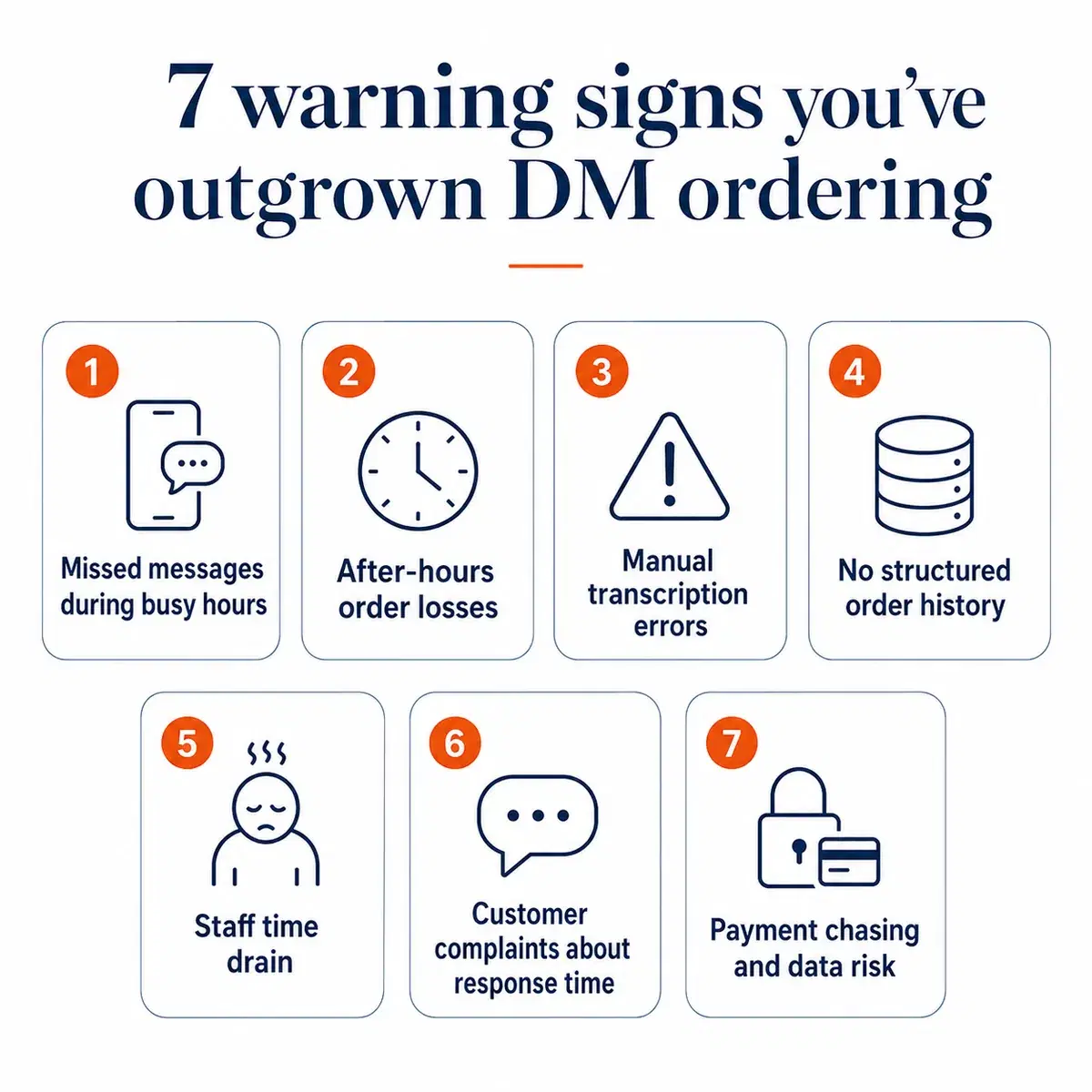
Missed messages during busy hours
Orders arrive faster than one person can read and acknowledge within five minutes. Lost sales you'll never see.
After-hours order losses
Around 40% of bookings and orders are attempted outside opening hours. A DM inbox does not take payment or confirm at midnight.
Order errors from manual transcription
Copying an address, a cake inscription, or 'no onions' from a chat thread into a notebook or POS is exactly where mistakes — and refunds — happen.
No structured order history
Chat threads are not a database. You cannot see your best customers, repeat-order rates, or what sold last month.
Staff time drain
Small business owners lose roughly 16 hours per week to manual admin. For chat-based sellers, order-taking and payment-chasing devour much of that.
Customer complaints about response time
When 'did you get my order?' becomes a frequent message, your channel itself is the bottleneck.
Payment chasing and GDPR risk
Manually confirming who paid, and storing names, addresses and order details inside Meta's apps, is both an operational drag and a real compliance exposure under EU law.
The hidden-cost math — a worked example
Plug your own numbers in. Most owners are shocked.
Take a small restaurant, busy florist, or boutique taking orders by DM and phone. The numbers below are realistic for a mid-sized EU operation.
Annual revenue lost to missed messages
- Order-related messages and calls per day
- 60
- Missed during peak hours (10%)
- 6 / day
- Of those, would have bought (60%)
- 3.6 / day
- Average order value
- €25
- Revenue lost per day
- €90
- Annual lost revenue
- €27,000+
Now add the labour cost.
EU average hourly labour cost was around €34.9 in 2025 (Eurostat). Even in lower-cost markets like Poland, labour costs continue to rise year on year.
If transcribing and chasing DM orders eats just two hours of paid staff time a day, that's another €20,000 per year spent on a task software does for almost nothing.
Combined, that's roughly €45,000+ a year a properly built ordering system could recover — for a small EU business doing 10–15 orders a day through chat, at the assumptions above. Your numbers will differ. The point isn't the exact figure — it's that the leak is almost always bigger than owners think.
The GDPR problem nobody talks about
This article is not legal advice. For your specific situation, consult counsel.
Here's the part most owners never hear from their marketing agency: storing customer data inside WhatsApp and Instagram DMs raises serious GDPR concerns — particularly in Germany and Austria, where data-protection authorities have taken the strictest interpretations.
GDPR rests on a few plain principles that matter here:
- Data minimisation — only collect what you actually need.
- Purpose limitation — only use data for the purpose the customer agreed to.
- A processor contract — if a third party (Meta, in this case) processes personal data on your behalf, you need a Data Processing Agreement. In German, an Auftragsverarbeitungsvertrag (AVV), under Article 28 GDPR. A missing or deficient AVV is itself a finable offence under Article 83(4).
Both the consumer WhatsApp app and the WhatsApp Business app have been repeatedly criticised by German data-protection authorities as difficult or impossible to use in a fully GDPR-compliant way for business purposes. The reasons cited: no adequate AVV is available to most small businesses, the address book typically syncs to US servers, and metadata is shared with Meta. Legal opinions vary, and some lawyers argue that careful configuration of WhatsApp Business can be defensible — but the safer reading, especially for German operators, is that this is contested legal ground.
The Landesbeauftragte für Datenschutz NRW stated in April 2025 that "WhatsApp und vergleichbare intransparente Messenger-Dienste" are "grundsätzlich unzulässig" for official use — a position that has driven scrutiny of business use as well, including enforcement action against a taxi company that shared customer data via WhatsApp.
The regulatory pressure is real: in 2021, Ireland's Data Protection Commission fined WhatsApp €225 million for GDPR transparency breaches. That fine targeted the platform itself, not its business users — but for small businesses, the practical risk isn't a headline fine. It's the missing AVV with Meta, a customer complaint to your local DPA, and the inability to demonstrate where your customer data actually lives.
A proper system on EU hosting, with a signed DPA and customer data you control, removes this exposure entirely. That matters disproportionately in Germany, where strict data norms make EU hosting a genuine selling point — not just a checkbox.
What a proper ordering system actually does
Strip away the jargon. Here's what you actually get.
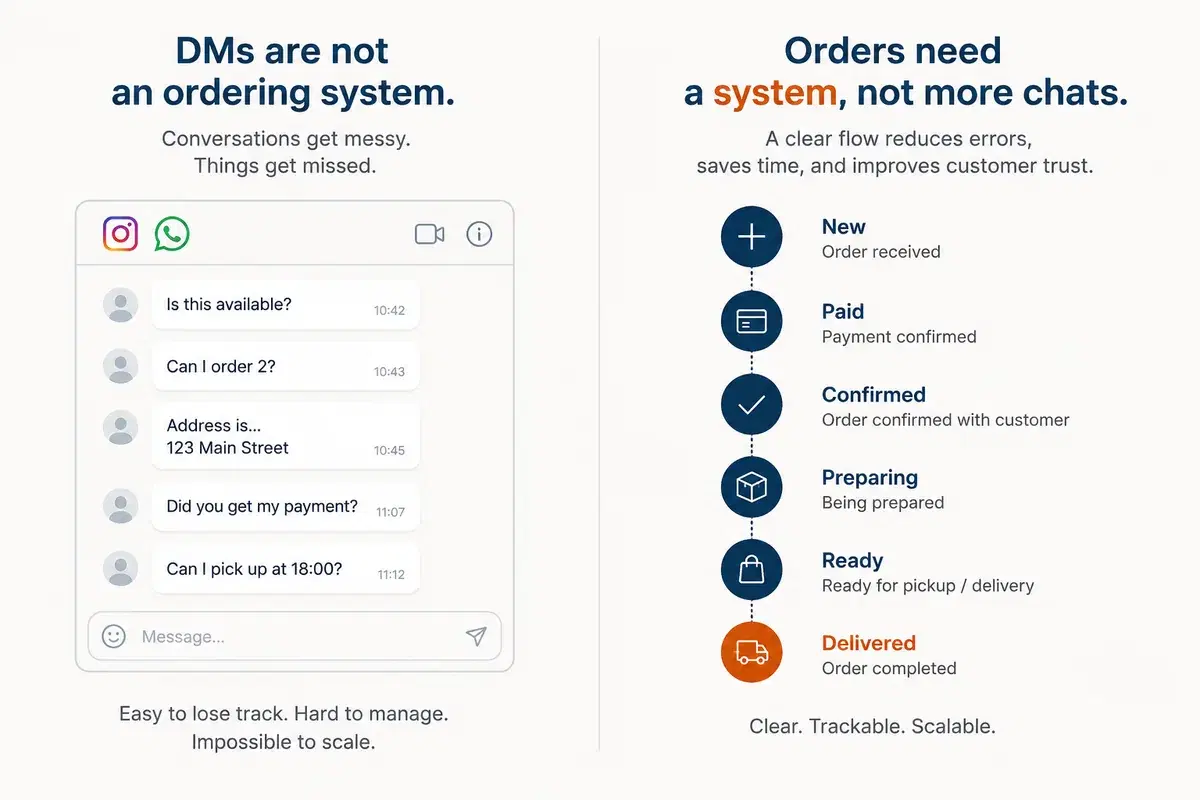
- A real catalogue or menu — customers browse and click to buy or book. No waiting for you to reply.
- Automated confirmations by email and SMS the moment an order lands.
- Integrated payment with the methods Europeans actually use: cards, PayPal, Klarna, SEPA — plus local heroes like BLIK in Poland (2.4 billion transactions in 2024), iDEAL in the Netherlands, Bancontact in Belgium, and pay-by-invoice in Germany.
- Order routing straight to the kitchen, workshop, or staff queue.
- Inventory sync so you don't sell what you don't have.
- Reporting — your best sellers, busiest hours, repeat customers.
- GDPR-compliant storage on EU servers with proper consent capture.
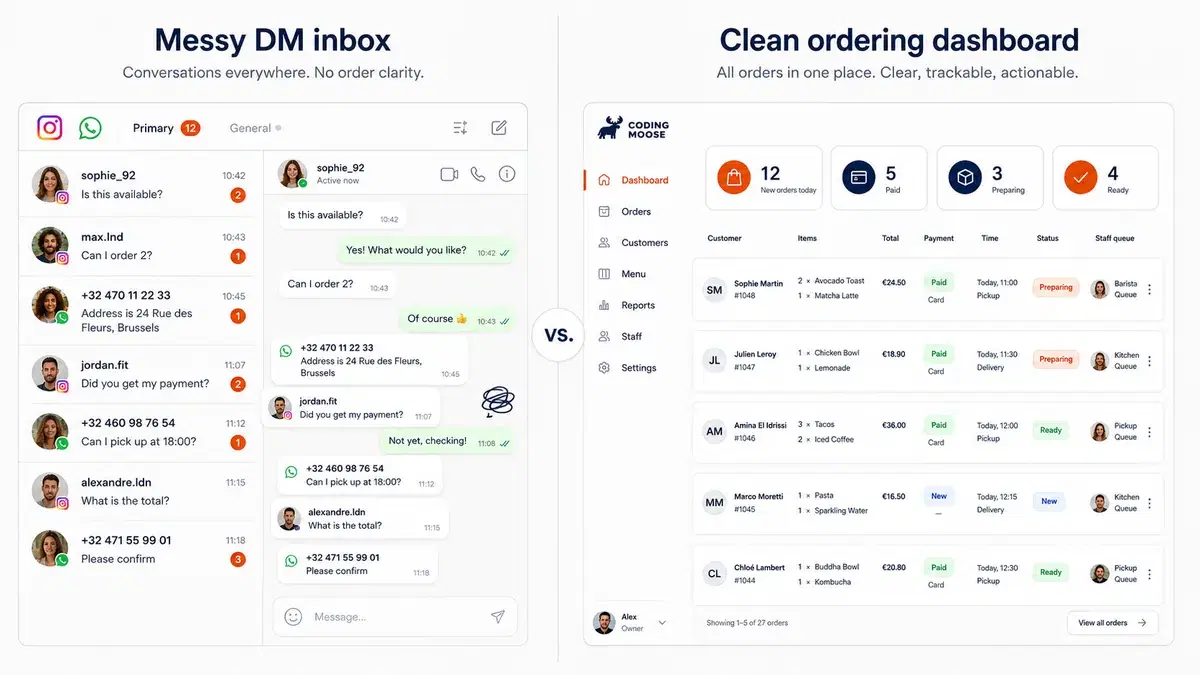
Build vs. buy: when SaaS is enough, when custom wins
The honest framework: SaaS first if it fits — custom only when the math justifies it.
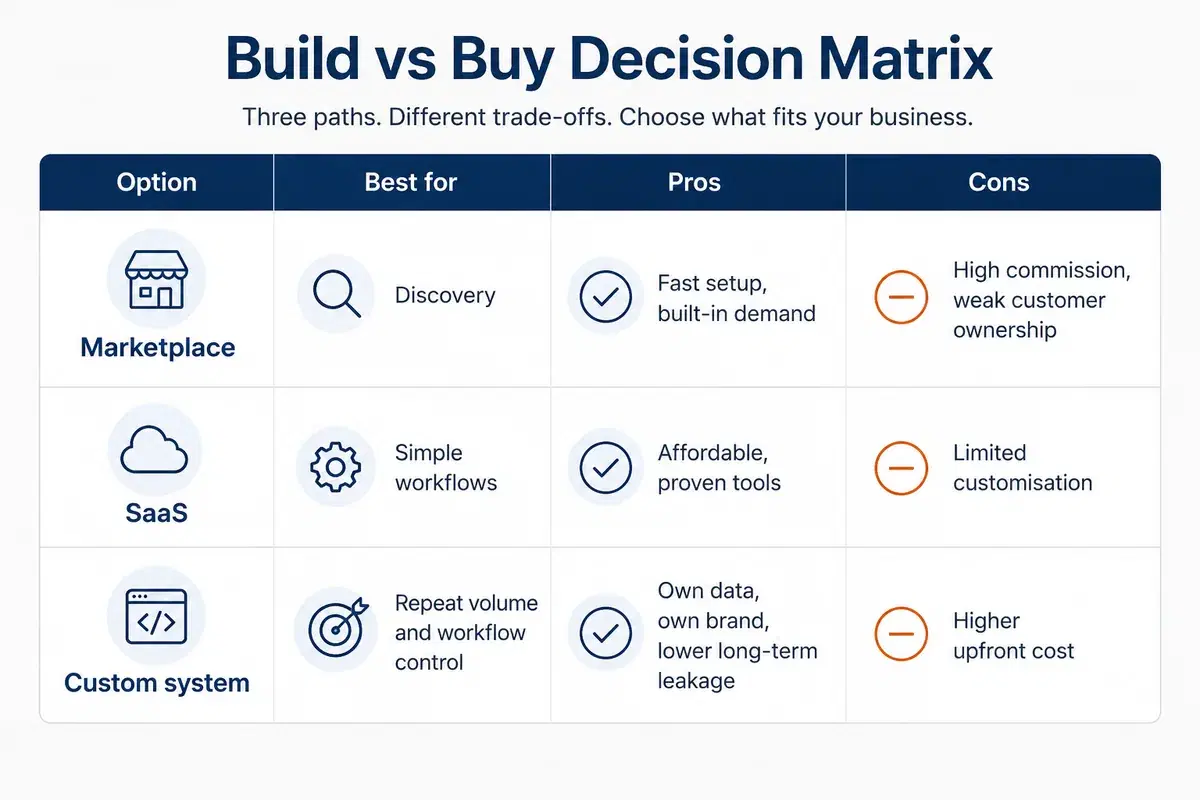
When SaaS or a marketplace is the right answer
Let's get this out of the way: for many SMBs, SaaS is genuinely the right answer — and you should not let any custom-software vendor (including us) talk you out of it.
Stick with marketplaces and SaaS when:
- You're under ~10 orders/day and don't yet have a repeat customer base. Discovery matters more than commission optimisation.
- You're still finding product-market fit and your offering changes monthly. Custom software ossifies; SaaS lets you pivot.
- You can't yet afford €2,000+ upfront. SaaS spreads cost. Custom requires capital.
- You genuinely benefit from marketplace discovery. A new salon, a new restaurant in a competitive area — UberEats / Booksy / Fresha bring real customers you wouldn't otherwise reach.
The right vertical SaaS for your business:
- Food: Wolt, Uber Eats, Glovo, Lieferando
- Beauty: Booksy, Fresha, Treatwell, Mindbody
- Retail: Shopify, WooCommerce
When custom starts to win
SaaS and marketplaces get you live fast. But as your business grows, the costs compound silently:
- Commission stacking. Restaurant delivery platforms take up to 30% (Lieferando, Wolt, Uber Eats comparison). Treatwell charges 35% on a new client's first marketplace booking. Fresha charges 20% (with a $6 minimum) on first-time bookings. On a €10,000/month delivery business, German operators have reported significant five-figure annual savings from leaving the platforms.
- No customer-data ownership. The platform keeps the email, the order history, the relationship. Per Fresha's own salon-software guide: "if a client hasn't visited in over 12 months, they're counted as 'new' again, so commissions can add up quickly."
- Brand dilution. Your loyal customer sees the competitor next door's discount in the same app.
Custom makes sense when you have steady repeat volume (so commission becomes pure leakage), you need workflow SaaS can't bend to, you want to own the customer relationship, or compliance and branding matter to your market.
The pragmatic play many growing businesses use: keep a marketplace for discovery, but push repeat customers to your own commission-free system.
How this looks in your industry
Same problem, different shape — depending on what you sell.
Highest call and message volume, thinnest margins, biggest after-hours loss. A custom ordering system plus EU payment methods captures takeaway demand that marketplaces otherwise tax at 30%.
Instagram is the storefront, but 'DM to buy' means manual stock checks and no cart. Lightweight e-commerce with inventory sync ends double-selling and endless 'is this still available?' threads.
A large share of bookings happen after hours. Treatwell and Fresha bring clients but charge 20–35% on new ones. A branded booking system with deposits cuts no-shows and keeps the client list yours.
Time-critical, address-heavy orders where transcription errors are costly. A structured order form with delivery date, card message, and payment removes the error-prone chat back-and-forth.
Custom cake orders are conversational by nature, but the order form, deposit, pickup slot and allergen info belong in a system — not a buried DM thread.
Implementation reality — for non-technical owners
"Custom software" sounds scary. Here's what it actually involves.
- Timeline. A booking or ordering system is a 1–2 month build. Not a multi-year IT project. You get a working test link in week one.
- Cost. Realistic European pricing starts at €3,900 for a booking system and €6,900 for e-commerce with inventory. Larger builds typically €3,900–€20,000 depending on integrations. Compare that to paying a marketplace 25–35% in perpetuity.
- Owning your source code. The software is yours. You can change vendors, extend it, or move it without being held hostage. Marketplaces and most SaaS give you none of this.
- Migration without losing customers. Run the new system alongside DMs for 2–4 weeks. Put the order link in your Instagram bio and auto-replies. Nudge regulars with a small first-order incentive. Only switch off chat ordering once repeat customers have moved over.
- Training. Because the system automates confirmations and routing, staff training is hours — not weeks.
What to do this week
Four concrete steps. Start with step 1 today.
A 4-step process for EU small businesses to transition from chat-based ordering to a structured, GDPR-compliant ordering system without losing customers.
Measure your leak
Count order-related messages and calls per day. Estimate your miss rate during peak hours. Multiply by your conversion rate and average order value. If the annual figure clears €5,000–€10,000, you've already justified building a real system.
Choose the right route for your volume
Under 10 orders/day and you just need discovery? Start with vertical SaaS — but read the commission terms and treat them as a customer-acquisition cost, not a permanent home. 10+ orders/day with repeat customers? Commission a custom build.
Insist on EU compliance
For German, Austrian, and EU-data-sensitive markets: require EU hosting, a signed DPA/AVV, and source-code ownership. Stop storing addresses and payment details in WhatsApp and Instagram threads regardless of which system you choose.
Migrate gradually
Run the new system alongside DMs for 2–4 weeks. Add the order link to Instagram bio and auto-replies. Offer regulars a small first-order incentive. Only switch off chat ordering once repeat customers have moved over.
Frequently asked questions
How many orders per day make Instagram DMs unsustainable?
Around 10–15 orders per day is the typical breaking point. At that volume, the math can turn against you: missed messages during peak hours, after-hours order losses, and manual transcription errors can cost a small business €20,000–€45,000+ per year in lost revenue and wasted labour, based on typical EU figures. Your exact number depends on order volume, average order value, and labour cost.
Is using WhatsApp Business for customer orders GDPR-compliant in the EU?
Not in most cases. German data protection authorities (including LDI NRW) have repeatedly criticised both consumer WhatsApp and WhatsApp Business apps for business use because no adequate Data Processing Agreement (AVV) is available and metadata flows to Meta. Storing customer addresses, payment details, and order data in chat threads creates real compliance exposure. Legal opinions vary; consult counsel for your specific situation.
How much does a custom ordering system cost in Europe?
Custom booking systems start around €3,900 and custom e-commerce with inventory starts around €6,900 from EU studios. Larger builds with complex integrations typically range €3,900–€20,000. Delivery time is 1–2 months. Compare this to paying marketplaces like Wolt, Uber Eats or Treatwell 20–35% commission in perpetuity.
What commission do food delivery and booking marketplaces charge in Europe?
Restaurant marketplaces like Wolt, Uber Eats, Glovo and Lieferando charge up to 30% commission on platform-delivered orders in Germany (around 13% for self-delivery/pickup). Beauty marketplaces: Treatwell charges 35% on a new client's first marketplace booking; Fresha 20% with a $6 minimum on first-time bookings. Rates verified as of May 2026 — confirm current terms with each platform.
What percentage of orders are placed outside business hours?
Approximately 40% of appointments and orders are attempted outside business hours, according to Zippia's appointment scheduling research. A DM-based system captures none of this demand because nobody is awake to reply.
Should I leave marketplaces like Wolt or Treatwell entirely?
Not necessarily. The pragmatic strategy: keep marketplaces for discovering new customers, but push repeat customers to your own commission-free system. Marketplace commission becomes pure leakage on repeat business — your own ordering system typically pays for itself within the first year for businesses doing €5,000+/month.
How long does customer patience last for a reply on Instagram or WhatsApp?
Modern customer expectations are under 5 minutes. Drift research shows waiting 5 minutes to respond increases the risk of losing a lead by 10×; waiting 10 minutes increases the risk by 100×. Most small businesses cannot meet this threshold by hand during busy hours.
A note on the numbers. Statistics quoted in this article draw on Eurostat labour-cost data, Drift lead-response research, Zippia appointment-scheduling research, Slang AI restaurant call-miss analysis, BLIK / Polski Standard Płatności 2024 transaction volumes, the Irish DPC's 2021 WhatsApp ruling, and platform-published commission rates from Treatwell, Fresha, and a Lieferando/Wolt/Uber Eats comparison. The €20,000–€45,000+ annual figure is a modelled illustration based on the stated assumptions (60 messages/day, 10% miss rate, 60% conversion, €25 AOV, 2 hours/day labour at EU averages) — not a measured industry average. The 30% / 8–15 min / 30-second figures are Coding Moose's measured results for The Place restaurant and may not generalise. Commission percentages vary by country, plan, and negotiation — verify current terms for your market before modelling. This article is not legal advice; consult counsel for specific GDPR questions.